
Middletown Previous Residents by Era
A sound previous-residents search works backward through the record layer that covers the period in question. Begin with the parcel and the County Clerk’s title trail when the goal is former ownership. Then use historical directories, newspapers, obituary notices, and census-era sources to check who was connected to the address. Ownership is not occupancy. A deed identifies parties to a recorded transfer, while a directory or another independently dated record can offer historical person-and-address context.
| Source | Years | Where Held | What It Shows |
|---|---|---|---|
| County grantor/grantee index books | 1910-1977 | Orange County Clerk Record Room | Name-to-instrument starting point for a dated title trail |
| County deed images | 12/24/1947-01/05/1978 | Orange County Clerk | Recorded deed images, Books 1071-2088 |
| SearchIQS land data | 12/31/1953-present | SearchIQS availability page | Indexed land data; back scanning is noted |
| County online land date sheet | 01/01/1978-present | Orange County Clerk online records | County-stated online land-record range, with prior scanning underway |
| Middletown city directories | 1871-1984 | Thrall microfilm | Historical name, street, and occupation or business context |
| Digitized Middletown Directory | 1857-1858 | Thrall page-image collection | Village reference and business-advertising context |
The coverage differences matter. Start with a directory, newspaper, historic map, or local-history lead for an early address. For a mid-century transfer, test the historical clerk books and available deed images. For later records, check the county’s stated online range but retain a Record Room fallback. No single line in the table proves that a person lived at the address.
Middletown Previous Residents Start With Parcels
Before tracing names, normalize the address. The Orange County Parcel Information route supports searches by owner name, address, tax-map number, and municipality. Check City of Middletown as the municipality where the search offers it. The parcel report supplies the bridge fields needed for an orderly search: situs address, SBL or tax-map number, municipality, assessment year, deed book and page or instrument number, and the owner name as printed.
Orange County GIS can search owner, address, or parcel ID, accepts partial strings, and provides an address locator using address, city, state, and ZIP. Its results can be zoomed or buffered, but the map is a research aid, not a legal survey or title determination. Compare its municipality field with the parcel report before treating a postal Middletown result as a city parcel.
Keep property location, mailing address, and ownership separate. The City Assessor’s address-change form distinguishes the property location from old and new owner mailing addresses. That is direct evidence that a mailing field cannot silently become an occupancy claim. The separate Middletown by-street directory route is the better place for current address-keyed research.
Note: Save the SBL, municipality, assessment year, and deed bridge before a name search, because old street wording may not match the modern parcel.
Orange County Dates Behind Past Residents
The online date labels should not be merged. The county’s Online Records date sheet lists land records from January 1, 1978 to the present and says earlier scanning is underway. It separately identifies historic grantor/grantee index books from 1910-1977 and deed images in Books 1071-2088 from December 24, 1947 through January 5, 1978. The SearchIQS availability page instead states land-record data from December 31, 1953 to the present, also with back scanning.
These may describe different layers, such as data, index, or image availability, but the sources do not reconcile them. Treat the difference as a question for the Record Room. Say whether a date comes from an image, an index book, an annual assessment roll, a GIS layer, or the vendor availability page. That discipline is essential when tracing past residents across the changing online record boundary.
Record Room tip. Bring the SBL, book and page, instrument number, names, and approximate date, then ask staff which index or image layer applies to the earlier transfer.
Trace Middletown Previous Residents Through Deeds
A chain of title follows recorded interests in the parcel, not a list of former occupants. Use the present parcel record to locate the most recent deed bridge, then work from the current buyer’s deed to the seller’s earlier acquisition. Check spelling variants and the legal description at each step. Confirm an index hit with a deed image or a clerk copy before placing it in the chain. A name match alone is weak, especially when the surname is common.
- Capture the current situs address, SBL, municipality, owner field, and deed book or instrument bridge from the parcel or assessment record.
- Locate the current transfer in the County Clerk index and record the grantor, grantee, instrument type, recording date, and book, page, or instrument number.
- Search the seller as a grantee to find the earlier acquisition, then compare its legal description with the parcel being traced.
- Repeat the process backward, marking the point where the online source changes from an image to an index or stops.
- Take the unresolved earlier edge to the Record Room’s historic books or staff-assisted copy route, with the chain notes in hand.
- Grantor
- The party transferring an interest in the recorded instrument.
- Grantee
- The party receiving that interest in the recorded instrument.
- Chain of title
- A dated sequence of recorded transfers or interests connected by the parcel’s legal description.
- Legal description
- The recorded parcel description used to distinguish land when a street address changes or is incomplete.
It is appropriate to preserve the role shown in each instrument: owner, buyer, seller, executor, trustee, or mortgage party. Do not relabel that role as a resident without independent historical evidence.
Middletown Address Names Need Checking
Historical Middletown searches can fail because the place name and road name changed. The city history records South Middletown as a name used from 1829 through 1849. It also identifies the old Minisink Road with modern East and West Main Street. Search the old and current forms in the exact period being studied, but keep the source spelling in the notes. A hit on a historical alias is a lead to map and verify, not an automatic modern address match.
City records did not establish a general citywide renumbering event. A conflict may instead reflect a business entrance, multi-address parcel, former street wording, postal-place difference, or a real change in numbering. Use a deed legal description, historical map, directory page, or city record to resolve it. Do not fill gaps by guessing which current number replaced an old one.
The Middletown maps page offers ward, street, zoning, and official-map context. It helps orient the address, while the parcel and deed records remain the tools for a title or municipality question.
Past Residents in Directories and Census
After building the ownership trail, add the household layer with records that were created to show historical people and places. Thrall’s city directories can connect a name with a street and a role for the publication year. The library’s microfilm collection covers 1871-1984, and its digitized 1857-1858 directory is a separate early resource. No separate official reverse or criss-cross run was verified, so ask whether a target volume contains a street-order section before looking for an address there.
Use census-era material as another dated household check rather than as an extension of the deed chain. Pair the nearest available directory with a census period, newspaper notice, obituary, or historic map. If a name vanishes from the directory, test several explanations: a move, death, omission, spelling change, or a shift in the volume’s indexing practice. The directory collections themselves are detailed on the Middletown city directories page.
- Choose a dated directory entry tied to the exact historical street wording.
- Compare the listing with the next available directory year, preserving any role or address change.
- Use the closest census-era source as an independent household check, not a title record.
- Search Thrall’s newspaper and obituary paths for a dated move, death, business notice, or address reference.
- Mark every conclusion as owner, historical occupant, business, or unresolved rather than merging those roles.
Middletown genealogy records provide an eligible historical vital-record route that can help close a family-history question. The city describes separate age thresholds, fee bands, and eligibility rules, so use that process for the event record rather than treating it as a general directory.
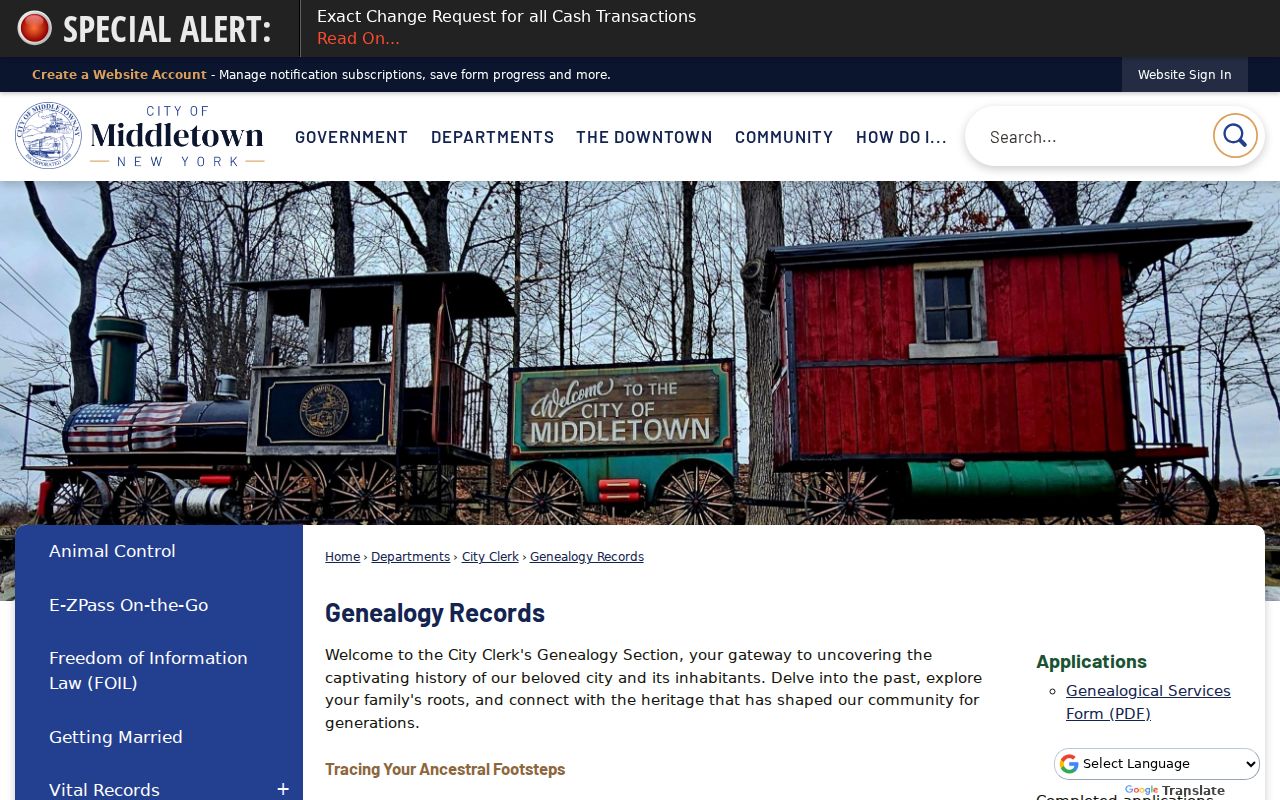
The genealogy page illustrates a custodian route for historical records. Save the application type, requested years, and source citation, then keep the result separate from a property ownership conclusion.
Middletown Record Room Copy Route
The Orange County Clerk Record Room is the in-person bridge when an online index leaves an earlier gap or an image needs confirmation. It has public computers and holds deeds, mortgages, assignments, liens, maps, business certificates, naturalization material, selected court records, and related indexes. Fragile and historical material may have access limits, so take the exact record type and identifying information rather than asking for every record about a person.
The Record Room page lists plain copies at $0.65 per page with a $1.30 minimum, and certified copies at $1.25 per page with a $5 minimum. A mail request should include the index number or record description and a self-addressed stamped envelope. Ask for the current routing before sending a request, because copy and document procedures can change.
Orange County’s Record Room is shown below as the public-computer and historical-index access path for a Middletown previous-residents search.
Bring the research log, SBL, names, dates, and book or instrument references. Staff can help identify the applicable historical index while the researcher retains the distinction between a recorded party and a historical occupant.
Note: Record the copy type and source identifier with every deed or index result, because an online index and a clerk copy can answer different questions.
Middletown Previous Residents, Used Carefully
House-history and family-history research works best when it follows documents, dates, and roles instead of trying to assemble a profile of living people. Historic photographs, directories, maps, tax records, and deeds can show how a place changed over time. They cannot establish present occupancy simply because an old address or family name appears in a source. If an address appears to involve a substitute address or other protected location, stop and use the appropriate custodian route.
Lawful use. Use Middletown previous-residents research for family history, house history, estate questions, or civic curiosity, never to harass, track, or expose a living person.
For a disputed or suspicious transfer, the county’s official deed-theft and fraud guidance is the appropriate route. A historic title gap or a name mismatch should lead to document verification, not a public accusation. The most useful final result is often a clear record trail, including the unresolved links.