
Middletown Resident Lookup Records
No single official roster lists everyone in Middletown. A resident lookup works by matching one narrow record to one narrow question. The county parcel system names an assessed owner. It also separates a property location from a mailing field. A recorded deed shows who signed a transfer. Court portals connect a name to a case, not a home. Historical directories at Thrall preserve old street and name entries for Middletown. New York's voter tool covers one registered voter's registration and poll site. It never returns a bulk list. Keep the date, record type, and jurisdiction attached to every result.
| Record | What It Confirms | Where | Access |
|---|---|---|---|
| Parcel or assessment roll | Assessed owner, situs, mailing field, and tax-map reference | Orange County Parcel Information | County search and year-specific roll |
| Recorded deed | Grantor, grantee, recording date, and legal description | Orange County Online Records | Online index or Record Room copy |
| Local civil docket | Party role, court, case date, and public status | WebCivil Local | Public index subject to court limits |
| Voter registration | Current registration, poll-site, or mail-ballot status | NYS VoterLookUp | Live individual lookup, not a bulk list |
| Vital or genealogy record | Life event, relationship, place, or historical index lead | NYS Vital Records | Eligibility and age rules apply |
| Historical directory | Dated name, street, and occupational context | Thrall Local History | Historical source, not current proof |
Match the record to the question. A title dispute points to the parcel, the assessment roll, and the deed trail. A court matter points to the right court and its clerk. Family history may call for an old city directory or an obituary. A lawful vital-record route may serve too. A Middletown resident lookup holds up best with corroboration. Two sources should agree on a middle initial, a date, a municipality, or a parcel number. A name alone proves little. Anchor every hit to a detail that separates it from the pack.
Purpose Before a Middletown Resident Lookup
Geography comes first. The name Middletown can point to the City of Middletown or the Town of Middletown. It can also mean a City mailing address, or a spot in the Town of Wallkill that simply uses the postal city. Before merging anything, check the county municipality selector, the parcel's situs, and the ZIP code directory entry. A city ward map helps with civic geography, yet it proves nothing about a household. Business service addresses, professional listings, and court filing addresses deserve the same caution. Each one describes a business or case relationship unless a current source says more.
Start with the least intrusive official route. The Orange County GIS address locator offers a Parcel Information search. It can pin an address to the right municipality and tax map. For an existing municipal record, a precise request to the City of Middletown can travel the City FOIL route. Under New York Freedom of Information Law, Public Officers Law Article 6, an agency has choices. It may release existing records or redact protected fields. It may also explain why a response needs more time. Building a brand new list of people is not part of that duty.
A credential filing is a different kind of lead entirely. Through the NYS Office of the Professions verification, you can search one profession at a time. Use three letters of a surname or a full license number. A hit may show a credential and a city or state address. That is not proof anyone lives there. Treat it apart from a Department of State service address or a County Clerk business filing.
Note: Before counting a hit as confirmed, log the source, date, address type, role, and one more identifying detail.
Verify a Middletown Resident Carefully
Anchor the name to something dated. That anchor could be an assessed parcel owner. It could also be a historical street directory entry, or a court party tied to a case number. Then test it against a second, independent record. A deed records a transfer, not occupancy. A voter result shows registration status and gives no permission to republish it. A court entry names a case role, not a verdict or a residence. That short sequence stops the classic same-name mistake in a Middletown residents directory search.
- Confirm the municipality, current or historical address, and date with the county parcel search, GIS, or a dated directory.
- Record the spelling, middle initial, suffix, role, source date, and whether the address is situs, mailing, service, or historical.
- Search the relevant court, voter, vital, or archive route using only the fields needed for that question.
- Compare a second discriminator such as a parcel number, spouse or parent in a historical record, index number, or publication date.
- Request an image, plain copy, or certified copy from the custodian only when the underlying record is needed.
Know what each document is. A certified copy comes from the record custodian and carries official weight. An index is only a finding aid. An image is the scanned record itself. The index may point you to the image. Neither one names the right person on its own; the surrounding facts do that.
- Docket
- A court’s case entry that records filings, appearances, and status information.
- Index and image
- An index helps locate a record; an image is the document or scanned page that must still be read in context.
- Certified copy
- A custodian-authenticated copy, distinct from an online listing or an informal printout.
- Situs
- The physical property location, which can differ from the owner’s mailing address.
Middletown Resident Lookup Court Fields
Middletown City Court hears local civil cases, traffic matters, misdemeanors, felony arraignments, and small claims. A listing in the residents directory may trace back to a court case. That listing is just a record of a filed matter. It says nothing about where someone lives now. It also settles no questions of guilt or outcome. Treat it as a pointer, not a verdict.
Older or certified papers take a different path in Middletown. Bring the index number, record type, filing date, and party or business name to Orange County Court Records. You can also try the County Clerk Record Room. Either office can pull the underlying file. The official Middletown City Court information page helps you choose between the court route and the clerk route.
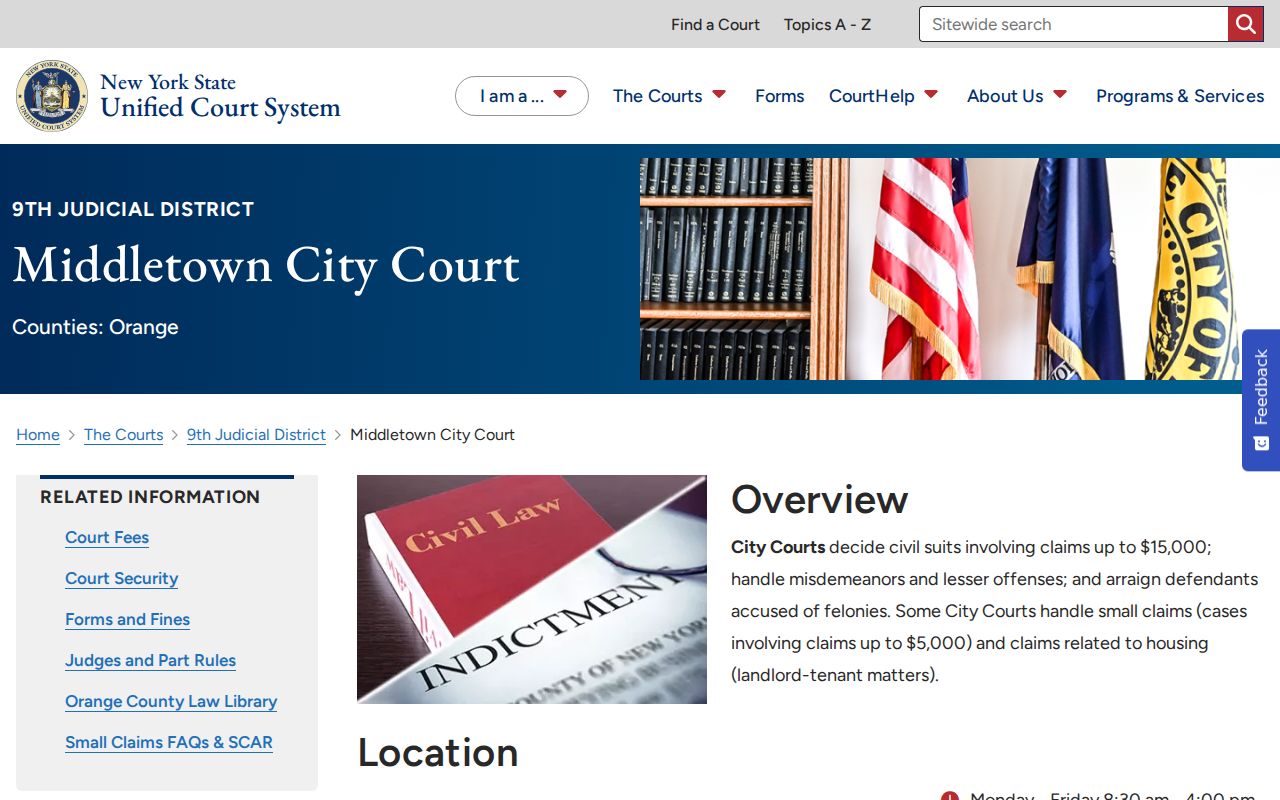
Middletown cases do not all sit in the same forum. The city court handles local matters. Supreme, County, Family, and Surrogate cases are heard in Goshen through Orange County. Knowing the forum first saves effort.
WebCivil Local serves New York's local civil courts with several routes. Those routes include Index Search, Party Search, Attorney/Firm Search, Judge Search, Court Calendars, Attorney/Firm Calendars, and eTrack. An index number is the tightest handle when you have one. A party search alone only gives a name lead. So keep the spelling, party role, court, case type, filing date, status, and any calendar date alongside it. The portal spans past, present, and future local civil information. It is still no substitute for the clerk's file. It is also not a universal Orange County index.
| WebCivil Local field | How to use it |
|---|---|
| Index Search | Use a known index number for the most precise case route. |
| Party Search | Use a name as a lead, then compare role, court, and date. |
| Attorney/Firm or Judge Search | Refine a case trail when the attorney or judge is already known. |
| Calendars and eTrack | Check scheduled activity or tracking, not a final outcome by itself. |
No docket layout applies to every search here. Treat the dependable fields as case or index number, court, party role, case type, filing date, public status, calendar date, and a final disposition when it is public and actually shown.
The WebCivil Local search screen lays out the available routes before any name is typed.
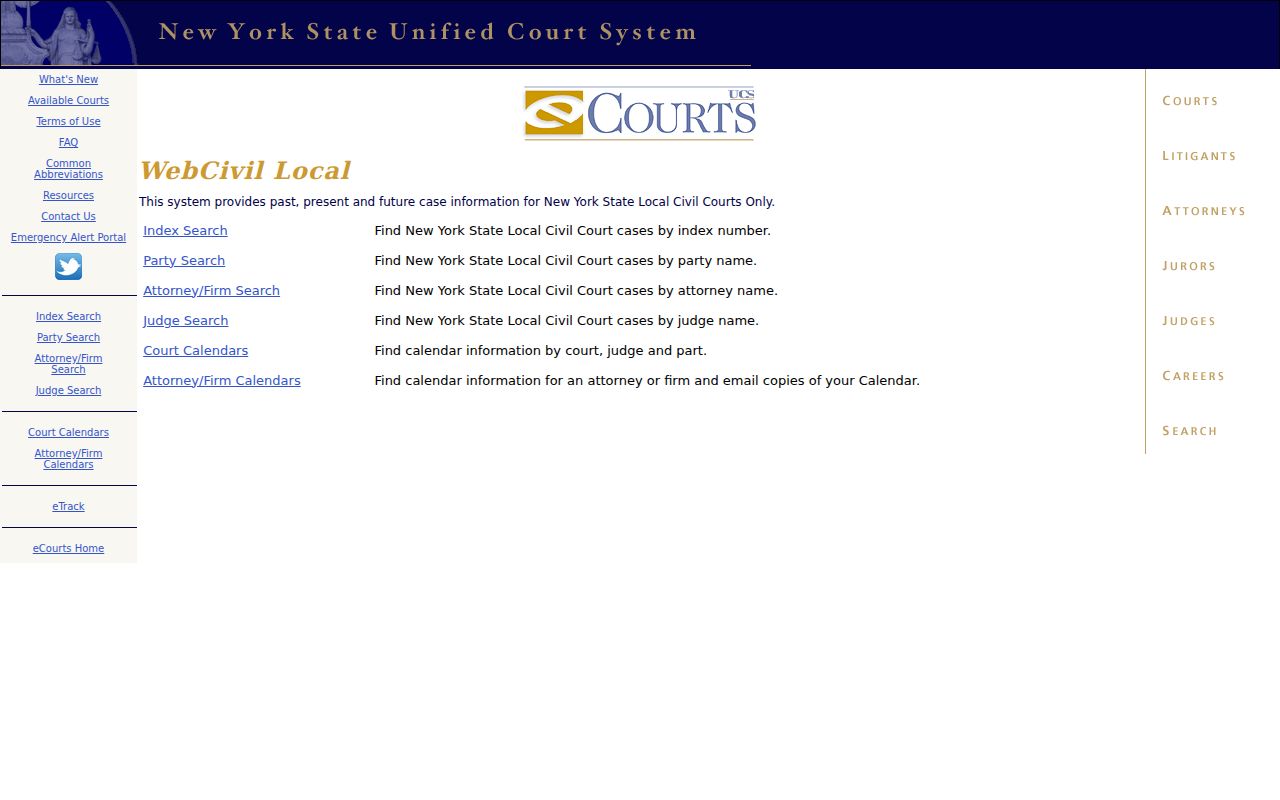
These search options work well for verifying a case. A common surname still demands a separate identifier before it can point to one Middletown person.
Read Middletown Court Status Precisely
WebCriminal covers selected New York criminal courts through Case Identifier, Defendant, and Court Calendar searches. Its landing page states the limits plainly. Only cases with future appearance dates appear, and updates can lag. A defendant name or a listed appearance is not a conviction. It is not residence evidence either. Note the court and status. Then ask the clerk for the public disposition when it matters. Sealed matters and protected categories stay outside ordinary public access.
The official WebCriminal landing page shows the defendant, case, and calendar paths it offers.
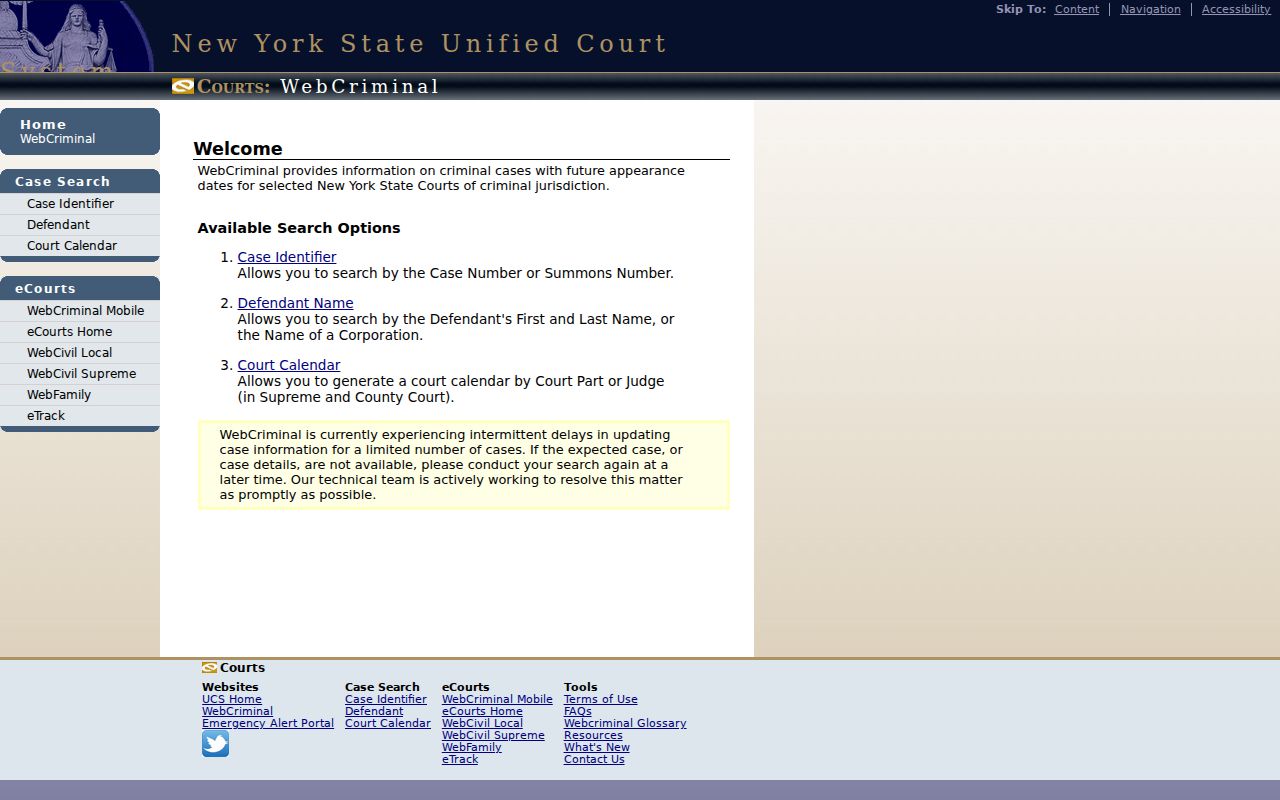
Treat any result as a narrow case lead. Do not merge it with a resident identity until court, role, date, and a lawful second identifier all agree.
Middletown Voter Lookup Has Narrow Scope
NYS VoterLookUp answers one need: a registered voter's current registration, poll site, and mail-ballot details. It asks for county, last name, first name, and date of birth in MM/DD/YYYY format. Address information and ZIP Code are also required. It is not a citywide resident list, and it is no substitute for corroboration. Election Law sections 3-220 and 5-602 govern public registration records and election-district lists. The same statutes shield driver-license, DMV, Social Security, and facsimile fields.
| Field or control | Purpose and limit |
|---|---|
| County | Selects the county for the current lookup. |
| Last and first name | Starts the name match; spelling variants still matter. |
| Date of birth | Narrows identity and should not be retained without need. |
| Address information and ZIP | Helps narrow location; a ZIP does not define a city limit. |
| Search result | Returns registration, poll-site, or mail-ballot information for a registered voter. |
For supervised inspection or a defined election-district request, contact the Orange County Board of Elections. The county publishes no current fee, delivery format, or public download form for an individual voter file. Ask the Board about its process rather than probing the live lookup.
Middletown Vital Records Are Conditional
The City Clerk holds local birth, marriage, and death records dating to 1881. Those files are not an open modern name directory, though. For an event inside city boundaries, use the Middletown vital-record route. The New York State Department of Health and local registrars keep separate eligibility rules. These cover statewide records outside New York City. A birth here proves an event location. It proves nothing about a current residence.
Genealogy follows its own path. New York releases a birth record at least 75 years old when the person is known deceased. A death or marriage record is released at least 50 years old under the stated deceased-person conditions. A documented direct-line descendant can qualify for an exception to the time period. The NYS Archives offers historical index leads rather than modern certificates. Adoption questions belong with the official Adoption Information Registry and its consent rules. They never belong in an informal name search.
Note: Record the event jurisdiction and record age before requesting a vital copy. City, state, and county routes cover different documents.
Middletown Record Requests Need Detail
When a public index cannot answer the question, ask the custodian for the existing record. The City of Middletown's FOIL form works best with a record type and date range. Include an address or parcel number. State a clear request for inspection or copies. The city posts electronic records at no charge. Physical copies cost 25 cents per page. State guidance gives an agency five business days to grant, deny, or acknowledge a request. Twenty business days may not be enough. A written reason and a date certain should follow.
A focused request beats "all information about" a person every time. Ask for a public index, an existing report, or a specified record. Redaction should be expected where personal privacy, safety, sealing, or another exemption applies. The Orange County Record Room offers public computers, plain and certified copies, and staff guidance. Its historical material may carry handling limits. Fragile records are the usual reason.
Middletown Resident Lookup Privacy Limits
New York lets the public see plenty. Yet it draws lines around what belongs in any profile. The Address Confidentiality Program is one such line. It gives eligible participants a substitute mailing address plus mail forwarding. Confidential voter registration sits apart from the usual public voter rolls too. A poll site, a parcel map, or a mailing field may hint at where someone lives. None of that licenses inferring a protected location. The same care applies to private phone numbers, signatures, needless dates of birth, minors' details, and sealed court material. It also covers adoption information and actual ACP addresses. Those stay out of any result set, full stop.
Know the difference between an official source and a commercial lookup category. An official record names its custodian. It shows its date and field limits, and often offers a copy or a correction route. A commercial category can blend stale or mismatched records. It can also hide where each one came from. For a Middletown resident lookup, favor the accountable custodian every time. Preserve uncertainty rather than guess past it. And when an error surfaces, fix it at the source that keeps the record.
Lawful use. Use records for a lawful personal purpose, such as family history, an estate question, civic research, or verifying a public record. Never use a result to stalk, harass, intimidate, or expose a protected person.